

The Search Behavior That Changed Everything
A founder at a Dallas healthcare services company recently told me her inbound lead quality had dropped while overall market demand was growing. The business was fine. The pipeline was thinning. She assumed it was a website problem. Maybe a messaging problem. She was looking at her Google Analytics and couldn’t see anything obviously wrong.
The problem wasn’t on her website. It was happening before her prospects ever opened a browser.
When a buyer today wants to know who handles fractional CMO work for healthcare companies in the Southwest, they don’t type a keyword into Google and scroll ten blue links. They open ChatGPT or Perplexity and ask a question in plain English. They get a synthesized answer with a short list of names. Then they validate. Then they contact someone on that list.
If your brand isn’t in that first synthesized answer, the conversation already happened without you.
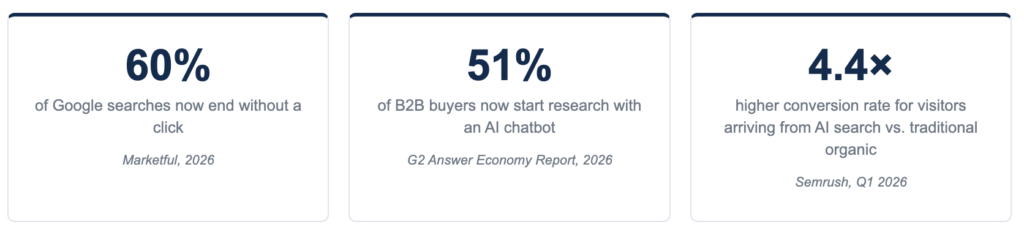
That last number deserves a pause. The visitors who arrive from AI-generated citations aren’t browsing. They’ve already done their research. They arrive pre-qualified, pre-educated, and often pre-sold on the category. The only question is whether your brand was in the answer they received.

This piece breaks down exactly where AI citation disrupts your funnel, why the impact is different at each stage, and what it takes to build citation authority deliberately. The goal isn’t to make you fluent in acronyms. The goal is to give you a clear picture of what’s actually happening in your buyer’s journey right now — and where the leverage is.
How AI Disrupts Each Stage of Your Funnel
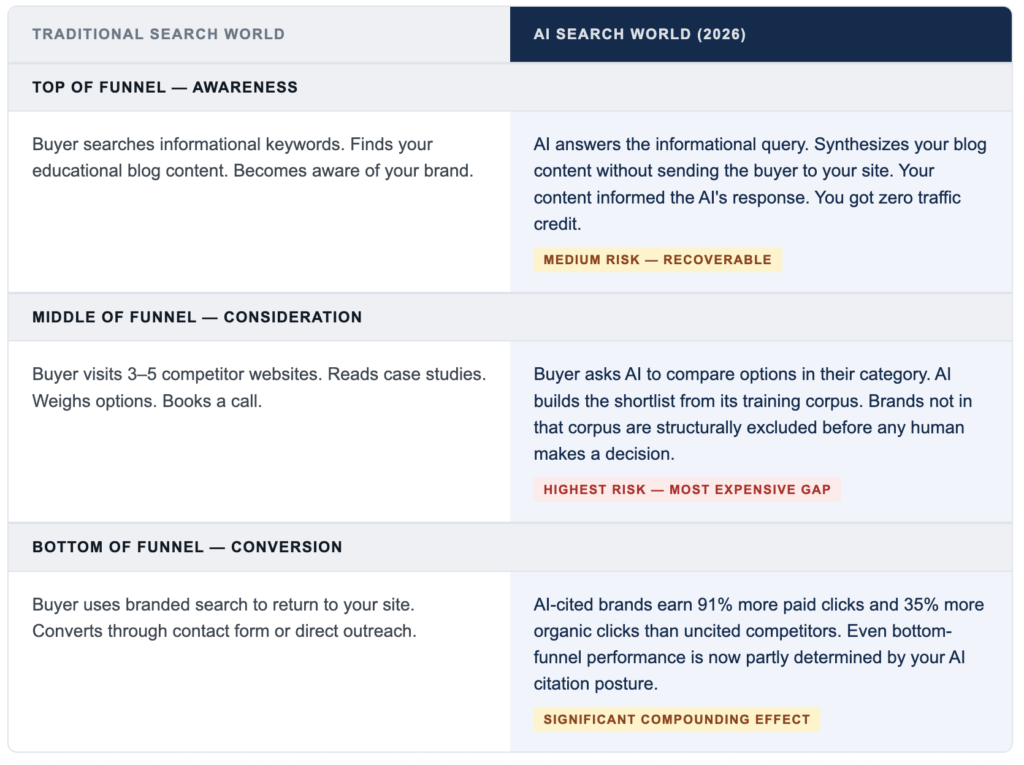
The funnel didn’t disappear. Awareness, consideration, and conversion still describe how buyers move toward a decision. What changed is who — or what — is doing the work at each stage, and which stage carries the most risk for brands that aren’t being cited.
The Before / After: What changed at each stage
Top of Funnel: The Invisible Audience Problem
Here’s the number that reframes everything about awareness content: only 8% of ChatGPT citations come from brand-owned content. Which means 92% of what AI says about your category comes from sources you don’t control — journalism, editorial coverage, research, expert commentary, third-party references.
The traditional TOFU playbook was: write educational content, rank for informational keywords, capture early-stage attention. That playbook still works in part. But AI is now handling the informational query that used to send buyers to your blog. Your content might be informing the AI’s answer. You just won’t see it in your analytics.
The shift at the top of funnel isn’t about abandoning content. It’s about changing who you’re writing for. You’re writing for third-party editorial credibility now as much as you’re writing for your own site. The content that gets cited isn’t the content that ranks. It’s the content that earns references from authoritative sources.
Middle of Funnel: Where the Shortlist Gets Built Without You
This is where AI citation has its highest revenue leverage, and where most SMBs are bleeding without knowing it.
When a buyer types “What are the best fractional CMOs for mid-sized healthcare companies in Texas?” into Perplexity or ChatGPT, the AI constructs an answer from whatever it considers authoritative in that category. It doesn’t browse your website in real time. It draws from its training data — earned editorial coverage, credible third-party mentions, structured content it can extract cleanly, and expert commentary from recognizable sources.
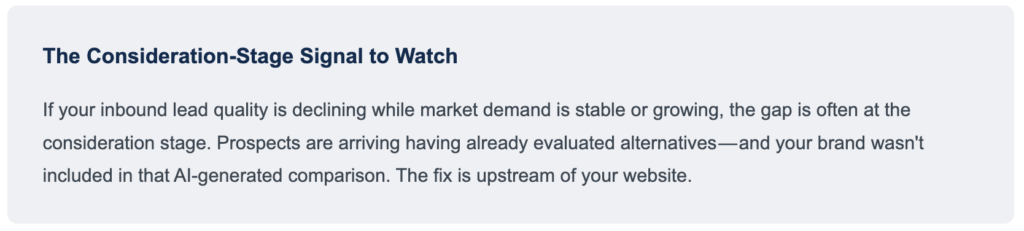
The Consideration-Stage Signal to Watch
If your inbound lead quality is declining while market demand is stable or growing, the gap is often at the consideration stage. Prospects are arriving having already evaluated alternatives — and your brand wasn’t included in that AI-generated comparison. The fix is upstream of your website.
The research is unambiguous on where the leverage sits: for consideration-stage queries, AI recommendations directly influence vendor shortlists. This is the most expensive citation gap for SMBs, and it’s the least visible in traditional analytics because the buyer never registered as a visitor in the first place.
Bottom of Funnel: The Compounding Penalty for the Uncited
Even if a buyer reaches your website directly, your paid and organic performance is now partly shaped by your AI citation posture. Seer Interactive’s 2025 research found that brands cited inside AI Overviews earn 91% more paid clicks and 35% more organic clicks than competitors who aren’t cited. The Google AI Overview appearing on that query didn’t hurt the cited brand. It amplified it.
This is the compounding dynamic that makes early action matter. Every quarter of citation authority you build makes the gap wider for competitors trying to catch up later.
What AI Actually Cites: E-E-A-T as Revenue Strategy
The SEO world has discussed E-E-A-T — Experience, Expertise, Authoritativeness, Trustworthiness — primarily as a content quality checklist. That framing undersells what’s actually happening. E-E-A-T describes the signal architecture that AI engines use to decide which brands belong on a shortlist. It’s not a writing rubric. It’s pipeline infrastructure.
Translated into revenue language:
- Experience means third-party sources reference your brand in specific, verifiable contexts. Press coverage. Case study citations. Industry publications naming you as a resource. Not what you say about yourself — what others say about you, in credible venues.
- Expertise means your category positioning is clear and consistent across every channel. AI synthesizes your brand from dozens of signals. If your positioning is fuzzy across your LinkedIn, your website, your PR, and your content, the AI builds a fuzzy picture — or ignores you entirely.
- Authoritativeness means credible external sources point at you. Not directories. Not paid placements. Journalism, editorial coverage, analyst mentions, expert roundups. The same sources that build trust with humans build trust with AI engines.
- Trustworthiness means your content is structured so AI can extract and cite it cleanly. Schema markup, clear factual claims, authoritative sourcing. If your content is hard for AI to parse, it gets skipped for something easier to use.
Here’s the strategic implication for SMBs that most people miss: this is winnable at your size. The Similarweb 2026 data shows specialist brands with genuine depth of subject-matter expertise already outperforming larger, better-funded competitors in AI citation share. AI doesn’t reward the loudest voice. It rewards the most credible one in a specific category. That’s a competition you can win without outspending anyone.

Building Citation Authority: What It Actually Requires
The honest answer to “how do I get cited by AI?” is: the same way you get cited by humans. You become genuinely authoritative in a specific category, you say things worth referencing in places worth referencing them, and you structure that content so it’s easy to extract.
That said, there are specific moves that accelerate the process for SMBs:
1. Earned Media Over Owned Media at the Top
Editorial coverage in industry publications, expert commentary in third-party articles, and PR placements that generate genuine citations are the highest-leverage TOFU investment right now. Not because owned content doesn’t matter, but because AI engines weight third-party credibility signals heavily. A single mention in a credible industry publication can do more citation work than ten blog posts.
2. Category Clarity Before Content Volume
The most common mistake I see SMB marketing teams make is producing high volumes of content before the positioning is clear. AI synthesizes your brand across every signal it can find. If your content covers ten different topics with no clear through-line, the AI can’t figure out what you’re authoritative about. Pick the specific category you want to own in AI responses. Then produce everything through that lens.
3. LinkedIn as a Citation Corpus
LinkedIn is one of the most actively indexed domains by major LLMs. Consistent, expert-positioned thought leadership on a single topic — published at a steady cadence over 90 days or more — builds a citation corpus that compounds. This isn’t about follower count. It’s about depth of expert signal in a category that AI engines can find and use.
4. Content Structure That AI Can Actually Extract
Content that AI citations come from isn’t necessarily the most beautiful or the most comprehensive. It’s the most parseable. Clear headings, specific factual claims, authoritative sourcing, FAQ structures, and clean schema markup all increase the probability that AI can extract and cite your content accurately.
5. Consistency Across Every Channel
AI builds its picture of your brand from dozens of signals simultaneously — your website, your LinkedIn, third-party mentions, editorial coverage, your content. If your positioning shifts between channels, the composite signal is weak. The brands earning consistent AI citation have consistent positioning everywhere a signal can be read.
Why This Is a Leadership Problem, Not a Content Problem
Here’s the pattern I see constantly. The marketing team is producing. Blog posts are going out. LinkedIn is active. The team is working hard. But the business isn’t showing up when their best prospects ask AI who to call.
The diagnosis almost always traces back to the same root cause: nobody made a deliberate decision about what authority signals to build, in which category, for which buyer, before the content started.
Content without positioning strategy is organized noise. And organized noise doesn’t get cited.
Building AI citation authority requires someone to answer four questions before any content gets produced:
- What specific category does this brand need to own in AI responses?
- Which buyer queries are shaping shortlists in that category?
- What does the current citation gap look like, and where is the highest-leverage place to close it?
- What does a 90-day authority-building program look like that compounds instead of resets every quarter?
Those aren’t questions a content team answers. They’re not questions an agency answers. They require someone with enough strategic authority and revenue accountability to make the positioning decisions that the content then executes against.
For most SMBs in the $10M–$75M range, that person isn’t a full-time hire. They’re a fractional CMO who embeds in the leadership team, owns the revenue number alongside the CEO, and builds the architecture the content team then executes within.
The companies spending ten times your budget on content? Most of them don’t have this system. They have more people, more tools, and more noise. You have the opportunity to have sharper positioning and a more coherent citation signal than any of them — if you build the strategy first.
Not sure where your AI citation gaps are?
Download the free AI Visibility Audit — a five-question diagnostic designed for SMB founders and CEOs to identify exactly where their brand is invisible to AI and where the highest-leverage fix lives.